


Popular Tags

Turkish Property VAT Exemption: 7 Powerful Benefits (2026) | TENHA LAW FIRM
Turkish property VAT exemption for foreign investors and citizenship buyers. TENHA LAW FIRM explains the 7 essential rules, payment conditions and risks.
Understanding Turkish Property VAT Exemption in a Citizenship Context
If you are planning to acquire Turkish citizenship through real estate investment, understanding the Turkish property VAT exemption can make a six-figure difference to your overall cost. Under Article 13/i of the Turkish VAT Law (KDVK), certain first deliveries of residential and commercial units to non-resident buyers can be completely exempt from VAT, subject to strict conditions.
For international investors and citizenship agencies, this is more than a technical detail. Real estate worth at least USD 400,000 must be purchased and held for three years to qualify for Turkish citizenship by investment. When the purchase is structured correctly, the same transaction can also benefit from VAT exemption, significantly reducing the total purchase cost while remaining fully compliant with Turkish tax law.
In this guide, TENHA LAW FIRM explains who can benefit from VAT exemption, the 7 essential rules you must follow, how the exemption interacts with the Turkish citizenship by investment (TCBI) program, and the key risks that can trigger retrospective VAT, penalties and interest.
Who Can Benefit from VAT Exemption on Turkish Property?
The VAT exemption under KDVK Article 13/i is designed to attract non-resident capital into Turkish real estate. It applies only to the first delivery of certain residential and commercial units and only for qualifying buyers.
Eligible buyers include:
1. Foreign Individuals (Non-Turkish Citizens)
- Must not be tax-resident in Turkey.
- Must not be habitually resident in Turkey.
2. Turkish Citizens Living Abroad
- Must hold a valid residence or work permit abroad.
- Must have stayed abroad more than six months within the relevant period.
- Persons assigned abroad by Turkish institutions do not qualify.
3. Foreign Companies
- Must have legal and business seat outside Turkey.
- Must not have a PE (permanent establishment) in Turkey.
To qualify for exemption, both the buyer and the property must satisfy specific legal requirements.
7 Essential Rules of VAT Exemption for Foreign Buyers
1. The Property Must Be Residential or Commercial (Not Land)
The exemption only covers residential (konut) and commercial (işyeri) units. It does not apply to land (arsa).
Always verify:
- Building licence (yapı ruhsatı)
- Title deed status (kat irtifakı / kat mülkiyeti)
2. It Must Be a First Delivery from the Developer
The exemption is available only for the first sale by the developer.
Resale properties do not qualify.
Exception:
If a developer retains units under an “arsa karşılığı inşaat” model, those sales can still qualify—if all other conditions are met.
3. Proper Building Licence & Title Structure Must Exist
A valid construction permit, and where applicable, established floor easement or condominium status must exist for the exemption.
For off-plan purchases, exemption is still possible if structured properly.
4. Property Must Be Delivered Ready for Use
In general, the property must be delivered ready for use (residential or commercial).
However, if condominium ownership (kat mülkiyeti) is already registered, proof of physical delivery is not separately required.
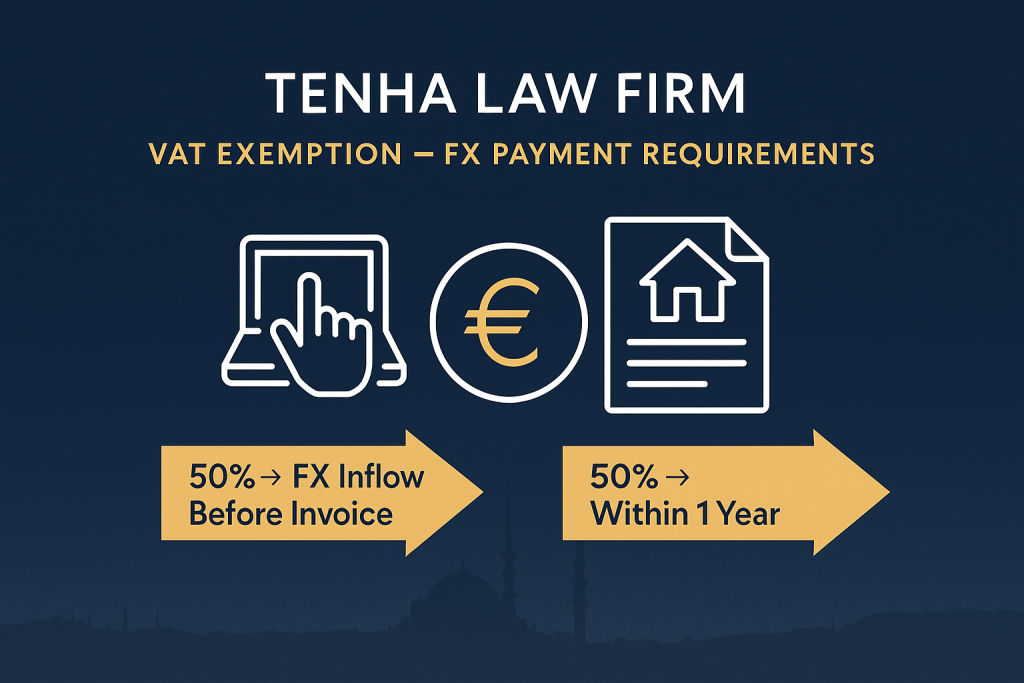
5. Foreign Currency Inflow Rule: 50% Before Invoice + 50% Within 1 Year
This is the most critical requirement.
To qualify:
- At least 50% of the purchase price must arrive in foreign currency before the invoice date.
- The remaining 50% must be paid in foreign currency within one year of the invoice.
Additional rules:
- All payments must be made via the banking system.
- FX can be exchanged into TRY before payment (DAB required).
- Foreign credit card payments can qualify if the Turkish bank confirms FX inflow.
Failure to comply jeopardises the entire exemption.
6. No Turkish Bank Loan for the Exempt Portion
Using a loan from a Turkish bank breaks the VAT exemption.
Permitted structure:
- Loan from a foreign bank → FX transferred to Turkey → Paid to seller
Not permitted:
- Turkish mortgage loan for any part of the exempt transaction.
7. 1-Year No-Sale Annotation (Separate from Citizenship’s 3-Year Rule)
The title deed office records a 1-year restriction.
If the property is sold within one year, the previously unpaid VAT becomes payable with late interest.
For citizenship:
- Property must be held for 3 years.
- This is separate and does not conflict with the VAT rule.
VAT Exemption and Turkish Citizenship by Investment: How They Interact
VAT exemption and citizenship by investment operate under different legal frameworks but can be combined seamlessly.
To combine both:
- Buyer must qualify as non-resident.
- Property must be a first delivery residence or office.
- FX inflow rules must be strictly followed.
- Citizenship rules (USD 400,000 minimum + 3-year annotation) must be met.
A single property investment may therefore simultaneously qualify for:
- Turkish Citizenship by Investment, and
- VAT Exemption under Article 13/i.
This requires careful structuring from day one.
Common Pitfalls and How TENHA LAW FIRM Protects You
Even sophisticated investors frequently make mistakes:
❌ Using a Turkish mortgage
- Breaks the VAT exemption.
Solution: We structure the financing to ensure compliance.
❌ Incorrect timing of FX inflows
- Late transfer = failed exemption.
Solution: We monitor the entire payment timeline.
❌ Buying a resale unit unknowingly
Solution: We perform full title and history due diligence.
❌ Incorrect tapu annotations
Solution: We manage the title registry process ourselves.
❌ Developer’s accountant mishandles VAT refund
Solution: We coordinate with the seller to ensure aligned tax filings.
TENHA LAW FIRM handles both citizenship and VAT structuring, creating a seamless process for agencies and investors.
Frequently Asked Questions About Turkish Property VAT Exemption
How does VAT exemption work for Turkish citizenship by investment?
If a non-resident buys a first delivery residential or commercial unit, pays in foreign currency under the strict timelines, and satisfies all documentation requirements, the sale can be VAT-exempt.
If the same property also meets the citizenship criteria (USD 400,000 minimum + 3-year holding), both benefits can apply.
2. Can I combine citizenship and VAT exemption?
Yes. There is no conflict between the two regimes.
3. What are the key conditions for VAT exemption?
-Non-resident buyer
-First delivery property
-FX inflow via Turkish banking system
-50% FX before invoice + remainder within 1 year
-1-year no-sale annotation
4. Must the entire price be brought in FX?
Practically, yes. To maintain exemption for the entire transaction, 100% of the price must come via foreign currency inflow following the legal timeline.
5. Can I use a Turkish bank mortgage?
No. A Turkish loan disqualifies the exemption.
6. What happens if I sell within one year?
VAT becomes fully payable with late interest and the tax office must approve the sale.
7. Who qualifies as a non-resident?
Foreign nationals-Turkish citizens living abroad (with residency/work permit + 6-month stay rule).
8. Can I buy more than one VAT-exempt property?
Yes, provided each transaction independently meets all conditions.
Conclusion: Taking Action on VAT-Optimised Citizenship Investments
Structuring a Turkish real estate purchase to achieve both VAT exemption and citizenship by investment requires precision. The rules cover buyer qualifications, property type, FX inflows, timelines, first delivery requirements, and holding periods.
TENHA LAW FIRM handles all aspects of:
- Turkish citizenship by investment
- Real estate due diligence
- VAT exemption compliance
- Payment structuring
- Tapu procedures
If you are an investor, wealth advisor, or CBI agency, we can provide a complete compliance roadmap and manage the entire legal process.
📞 Contact TENHA LAW FIRM today for a consultation.
Key Takeaways
- VAT exemption significantly lowers property acquisition cost.
- Applies only to first delivery residential/commercial units.
- Strict FX inflow rules must be followed (50% before invoice + rest within 1 year).
- Turkish bank loans break the exemption.
- VAT’s 1-year restriction and citizenship’s 3-year restriction operate in parallel.
- TENHA LAW FIRM provides integrated structuring for both regimes.

Legal Disclaimer
This article provides general information and does not constitute legal or tax advice. Laws and administrative practices change. For personalised guidance, consult TENHA LAW FIRM.
Related Articles from TENHA LAW FIRM
- Turkish Citizenship by Investment: 7 Essential Success Factors (2025)
- M&A Due Diligence & Engagement Letters under Turkish Law
- Turkish Bank Deposit Route for Citizenship
- Real Estate Due Diligence Checklist for Foreign Investors in Turkey


